October 12, 2017

The Nightmare of Noncommunication

It's pretty well-established in our class that The Metamorphosis is dreamlike, if not nightmarish. It's surreal, everyone jumps to conclusions (dream logic), and of course there's the giant bug thing. However, I think the most terrifying, nightmarish part about the whole affair is Gregor's inability to communicate.

Think about it: Say Gregor had kept his human face, like in Kuper's comic adaptation. Or maybe he kept his ability to speak.
His family understands all the excuses he gives when they first see him. Maybe he asks a family member to dial the telephone for him, so he can talk to his boss. He and his sister sit in his room, talking, while he explains how nice it feels to hang from the ceiling. Maybe he even gains more sympathy from his family, who realize how terrible they've been to Gregor. (Okay, maybe that one is a stretch.) My point is that with the power of communication, Gregor's dehumanization grinds to a stop. His physical disabilities can be overcome by help from family, who wouldn't be disgusted by him if they could know for certain that he understands them, and can know what he's thinking.

The Metamorphosis is nightmarish because Gregor has lost all that power. He's surrounded by family, but can't talk to any of them. He feels unimportant and useless, moping in his room as he is unable to talk to anyone. In Act III, he fantasizes about [dragging his sister into his room and] whispering in her ear about his plans to send her to Conservatory. He's dreaming about communication! Does he know that his family can't understand him? I honestly can't tell. We can infer that they probably can't- he talks to them enough, and they always respond with the same revulsion and terror.

And isn't that a nightmarish idea? Inability to communicate, while everyone thinks you're too far gone and revolting to be saved. Gregor can't even use his writing desk, and because of that dream logic nobody ever tries any "blink twice for yes" stuff on him.

In the Samsa-Seuss communication we talked about in class, Gregor says he has communicated to Seuss by means of beating a typewriter repeatedly with his face (and still talks loquaciously, which was amusing to imagine). In that 'alternate world' in which Gregor writes to Seuss, he can use a typewriter. More importantly, he managed to get someone to fold up the letter, address it, and send it off to Seuss. If you think about that too closely, some holes develop in the story. Would Gregor's family still have abandoned him if they could understand him?

September 28, 2017

The Sun Also Rises: An Autobiography

One of the main themes of The Sun Also Rises is Jake's focus on his own masculinity. He likes bullfights, fishing, and drinking, plus putting on the facade of being tough. We talked in class about how "Papa" Ernest Hemingway liked bullfights, fishing, drinking, and being a manly-man (especially as he grew older and got more famous). Of course, every author writes from experience, but I did some more research on Hemingway in order to make more comparisons.

From Wikipedia:
"Hemingway was raised in Oak Park, Illinois. After high school, he reported for a few months for The Kansas City Star..."

So we have a guy who was raised in the Midwest and was a newspaper reporter. Right after Ernest got out of high school in 1917, his father wrote to a classmate in Kansas to secure him the job (because he didn't want him going off to war.) Hemingway spent about a year in Kansas in total, and the Kansas City Star likes to brag that this time was "one of the most important periods of his life." Kansas does seem to show up in a lot of his works: Hemingway liked to "recast" scenes from his life into his books.

"Hemingway took the train to Kansas City in mid-October, arriving on Oct. 15, 1917. Dr. Hemingway accompanied him to the station. Ernest, who "was disgusted with teary fairwells,'' recast that scene in For Whom the Bell Tolls."
Source

In 1918, Hemingway went to war on the Italian Front, only to be seriously injured. (Sound familiar?) He fell in love with the nurse who was healing him. That nurse, Agnes Von Kurowsky, would leave him for an Italian officer. He went back to America to be a reporter until 1921, when he and his wife left for Paris. "In Paris, Hemingway met writers such as Gertrude Stein, James Joyce, and Ezra Pound who "could help a young writer up the rungs of a career"."

A bunch of American expatriates at a cafe table in Spain, drinking heavily...

In 1923, Hemingway and his wife Hadley went to the San Fermin festival (as we've said, mostly unknown until The Sun) with some friends from Paris. Hemingway started to get interested in bullfighting here. "A few days after the fiesta ended, on his birthday (July 21), he began to write the draft of what would become The Sun Also Rises, finishing eight weeks later." Source

There are a lot of comparisons to be made here, even besides the obvious ones.  It was fascinating to see the bits and pieces of the author's life that contributed to his first novel, and how he sculpted them into the complex story we can still read deep themes into today. This blog post is getting too long already, though, so I'll leave that to commenters.

(Hilariously, I found this bit while researching:"Hemingway suffered a severe injury in their Paris bathroom when he pulled a skylight down on his head thinking he was pulling on a toilet chain. This left him with a prominent forehead scar, which he carried for the rest of his life. When Hemingway was asked about the scar, he was reluctant to answer." Source)

September 15, 2017

Life Imitates Art??

These introspective, complex novels are really changing how I see the world and what I notice.

Last weekend, my mom and I went to visit an decades-long family friend named Maureen, who had just finished up a garage sale and was cleaning up the last few tables as we pulled up. After quick greetings, both she and my mother lapsed into chatting about what was happening recently, jobs, and all the other stuff middle-aged women like to talk about. Having been reading Mrs. Dalloway for weeks, I've been feeling more attuned to social intricacies and the idea of what isn't said. As Maureen told us a story about her garage sale, I noticed details and came to conclusions I wouldn't have caught before.

Maureen leaned into the car window and told us conspiratorially (and slightly grumpily) about one neighborhood girl that had scored a lot of free stuff out of her garage sale. The girl had wandered around the tables, looking through antique hats and dresses before asking for one of the matryoshka dolls. [as she spoke, I watched a tweenage girl pedal on a pink bike out of the next garage around the bend.] "I mean, I let her have one. It wouldn't do any harm, and plus I would hate to be that mean neighbor, you know. So I gave it to her." She paused as the girl on the bicycle pulled up behind the car, dismounted, and came up to her. They had a brief, cordial conversation; I heard something about "the dress" and "you'll have to wait 'till later on that." The girl hopped on her bike and rode away happily.

"That was the girl," Maureen said. I asked about "the dress?", and learned that the girl had also asked to have a vintage flapper dress (for free!) from Maureen's collection and Maureen had hesitantly told her to wait on it.

She continued to tell stories of this girl and later her little brother, both of whom had skulked around the tables the whole time investigating antique silver letter openers ("which they didn't need, and I told them they didn't need"), wooden toys, and the like. They even started putting items into their pockets! At this point, I could feel myself starting to dislike this girl, this family, whose children thought it was ok to boldly ask for and pocket more free stuff after just having received free stuff. I did remind myself there was more to people than met the eye, but I was having trouble seeing it with this rude, cookie cutter couple of kids. Next door, I saw a generic-looking father-type guy step out onto the porch with a fluffy sheepdog.

"Yeah, I really like that family though." Maureen watched the man idly through the windshield as he threw a ball to the dog. "You know, the other day, it was the middle of the night, I saw an ambulance pull up to their house. There was a gurney and-- Yeah. You know, I was just sitting in my room at my window, just watching and thinking, "Who's gonna die. Who's died."

And bam, my perspective changed. That family, that looked so boring and tame on the outside to someone who might have just been driving by as the little girl pedaled out on her bike, or as the sheepdog caught the ball, had had an ambulance wailing on its curb just nights before. By looking at them, you wouldn't have any idea that his wife, her mother had been carried out on a stretcher. They gave no indication, showed no wounds, so who would know?

Now that it's written down, this seems more unrelated to 20th Century Novel than I intended, but I believe it shows a real-life example of what Woolf knew, and what we're starting to see Hemingway illustrating: People don't say everything they know when they talk, and they show even less to the world at large. Just as Clarissa put on her public face, just as Jake Barnes narrates the top 5% of the iceberg, people tend to wear and speak with a facade that masks vulnerabilities and insecurities. Had we decided not to stop at Maureen's and just driven down the avenue, we might have spotted the family. And of course, we would have had no idea of their drama! Even crazier, you could extend that logic to anyone. Like the proverb goes, everyone you meet is fighting their own battles. Maybe not everyone's mother recently almost died, but it's incredible to think that everyone you meet, or don't meet, has complex, complicated problems as much as you do.

(Fun fact: That feeling is called Sonder, according to a tumblr blog and Urban Dictionary. Trustworthy sources, but just knowing it's documented makes you feel a little smaller.)

August 31, 2017

Mrs. Dalloway's Moving Castle

In reading Mrs. Dalloway, I keep getting imagery of Howl's Moving Castle (the Miyazaki movie). For those unfamiliar with it, the story comes from a 1986 book by Diana Wynne Jones. The main story involves magic, sorcerers, and curse-breaking. However, the points and ideas that stuck out to me as similar to Mrs. Dalloway's involved the setting and a few of the characters.
Sophie works in a hat-shop in a town called Market Chipping, in the fantasy world of Ingary. She is turned into an old woman by an evil witch until she can break her curse. However, the somewhat unlucky, dull Sophie realizes that she was kind of an old woman in personality already, and it's sort of her natural state. She sets off to find a new place in the world, and stumbles upon the wizard Howl.

The whole idea of an old woman who simultaneously feels young yet old is really epitomized here: she's literally both at once. Much like Clarissa, she spends a lot of time thinking about her "past" and when she was younger (technically last week, but) and thinks she isn't beautiful at all. Sophie really just seems very Clarissa-like in her manner, always getting lost in thoughts and not thinking of herself as important at all. Also like Clarissa, she is strong-willed, kind, and considerate, if a little impulsive. 
Some of the opening scenes in Dalloway really remind me of the images in Howl's...
Mostly the images of a prim, straight-backed woman taking a walk in a crowded city. Miyazaki's admittedly more steampunk machines and automobiles still show lot of similarities to Woolf's realism.
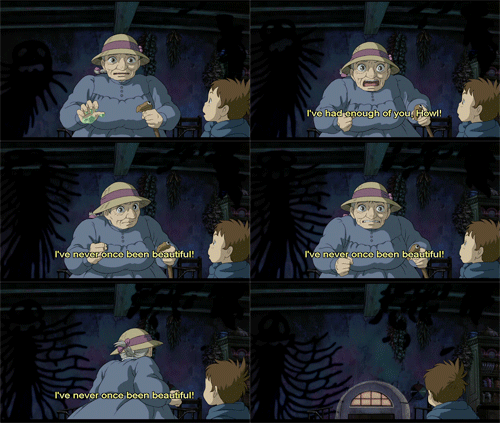
Here we have Sophie's sister in the story, Lettie. She reminds me a lot of Lucrezia as she takes care of Sophie, who, as we see, is rather absent-minded and apathetic, much like Septimus is, outwardly. 

 Lucrezia and Clarissa don't know each other in Mrs.  Dalloway, but if they did, I feel like it would be a lot like that right-hand gif. That interaction definitely happens between Rezia and Septimus several times throughout the book.


Now for the big similarity I see- setting. I've alluded to this a few times, but the time and place setting of both stories are similar.  The land of Ingary resembles a steampunky, fantasy early 20th century London.We first meet Sophie in Market Chipping, a smaller town full of hat shops, flower shops, and people who buy frivolous things from them. This world differs from June 1923 in that Ingary is not a post-war setting; instead it is currently at war with Strangia and High Norland, neighboring countries. Its capital is Kingsbury, and Sophie spends some time there as well. Kingsbury especially reminds me of Clarissa's London, with huge towers and orderly hustle and bustle.


this picture formatting is making me want to kill someone


I love the visuals of people taking strolls past this big statue: it really evokes those images that Peter, Rezia, and Septimus see in Regent's Park (in p. 69-71) of all these calm, dignified people going about their day.


(There's also a port scene which I vaguely remember, maybe from at Bourton? I got a strong mental image of this shot from Howl's Moving Castle:
)

I wonder if Miyazaki or his art staff had read Dalloway, or if 1920s England was such an iconic era that it's so instantly recognizable.

I also thought about making comparisons between Howl and Peter, but I'll save that slightly more sticky comparison for other posts and/or other commenters.