February 10, 2018

Bias and Butterflies

Bias and lying by omission is the easiest kind to do, intentionally or not. If no records exist for, say, a certain French peasant circa 1400, you’d be forgiven for not knowing their life story. But an omniscient historian with infinite historical knowledge could still tell a biased story by not writing every single detail into their historical account. An “annal history” of every single factual event that happened in human history, in chronological order and with (somehow) no subjective wording would be great. It would also be a gazillion pages long, and near impossible to use/read. So in order for it to be usable, you would create condensed versions. And is that French peasant REALLY important to your “exhaustive history of the American Wild West”? Of course! Had that French peasant not moved his cart during a rainstorm, a tree would have fallen on the daughter of a visiting merchant—who, of course, would be the great x15 grandmother of Buffalo Bill. And what is the Wild West without Buffalo Bill?

You’ve probably heard of the butterfly effect, which says that a butterfly flapping its wings affects human events far in the future. Maybe a butterfly flap caused a minute change in weather patterns that would warp into a tornado that destroyed Rome. If all of human history is interconnected, you really can’t tell the complete (and therefore not inherently biased) story of one thing without talking about everything that has ever happened. It’s a little ad absurdum, but I like thinking about history, and the sheer chance that everything turned out the way it did because of one little butterfly.


Kind of related to bias by omission is bias by narration. A king living in his palace knows his life: his surroundings, his food, his drink, his opinions and ideology. And as the most powerful and influential person in the area, his knowledge is a reasonable  “history.” Then imagine the scribe of the annals we read in class, who writes “712. Flood everywhere. / 713. / 714. Pippin, mayor of the palace, died. /715. 716. 717.” Presumably nothing happened in 713, 715, 716, or 717 that was of interest to the scribe or to the town of Saint Gall. But what about the history and story of the 709 hard winter during which Bede the presbyter had a religious experience, which caused him to become Blessed Bede by the time he died in 731? (A little bit of a ridiculous example, but made to show how the private lives of the common people can have a big impact later.) The king and the scribe are not wrong to say “these things happened and are important.” Bede the presbyter is not wrong to say “my life happened and is important.” But for the most complete, unbiased historical account we would need both the history of the common people and of the king. Of course, we don’t get it because records of kings tend to be better preserved than those of poor, illiterate peasants.

p.s. tell me if my blog is doing that thing where it runs off the side of the page. 

January 26, 2018

Why do Postmodernists Do Weird Things?


During class, we were discussing techniques of postmodernist writers. I mentioned the tactic of making up artificial constructs and unbelievable plot points (on this planet yawning is illegal!!! on this planet all the trees are made of plastic!!) to draw attention to Planet Earth’s own weird and arbitrary constructs (an idea or theory containing various conceptual elements, typically one considered to be subjective and not based on empirical evidence. Amusingly, the example given is "history is largely an ideological construct."). It occurred to me that the attention-grabbing is not the only reason to use such devices. For one, the author could be just poking fun, saying “what if?” Doctorow loves to flaunt this power, telling us that of course this all happened, that Ford and Morgan and Houdini and the family and all these people had these meetings that history never noticed. 

A postmodernist author might also just make unbelievable things up, well, just for the hell of it. And Doctorow does this a lot (see: Little Boy as God theories, all the chance meetings, tiny amusing details) but I wanted to bring in a favorite postmodernist sci-fi author of mine, Douglas Adams. You know, the guy who wrote about all the dolphins leaving earth before the apocalypse because they’re way smarter than humans, and decided that their parting words to their favorite marine biologist would be “So long, and thanks for all the fish.” Hitchhiker’s Guide to the Universe is full of stupid, funny quirks like that. Think of the swamp planet Squornshellous Zeta, which is home to living mattresses who are "slaughtered, dried out, and shipped around the galaxy to be slept on by grateful customers." source. Or maybe the time a character met Thor, and due to "a rather classless sub-etha video (involving a latex bustier and Damogranian pom-pom squids) ..." making him "the 68th most popular deity in the universe." Agreeing that all kinds of deities are real, then deciding that people would rank them-- How postmodernist is that? (for the curious: the 67th most popular deity is Skaoi, god of snowshoes.)

A more modern equivalent might be Guardians of the Galaxy, which utilizes the same sheer enjoyment of weirdness and eccentricity for entertainment and amusement value. Doctorow's pointed what-ifs don't quite fit into that same class of just-plain-weird current and postmodernist stuff. Somehow, Doctorow takes himself more seriously than someone.

There's a lot more to be said on this topic, and I'd love to be contested in the comments.


January 18, 2018

This is a new blog

Yep. This is now a History as Fiction blog instead of a 20th Century Novel one. Accepting better, punnier new name suggestions in the comments below.

December 20, 2017

Guitar's Revenge, and History in the Making

So in Song of Solomon, Guitar is part of the 7 Days society. You know, the one that revenges white acts of violence on black people by equal and opposite (sorry, Juniors) killings of white people. Notably, its whole thing was secrecy, so we don't know if it actually existed. In any case, Guitar is in charge of Sunday, and it's explicitly stated that what he's working on (and what he needs the inheritance money for) is revenging the Birmingham Church Bombing, which killed four young black girls in 1963.

The reason Guitar is so angry about stuff like this, and the reason he joined the 7 Days society was that nothing was being done. He laments that the people who set the bomb were not persecuted, and he is angry at how little society and the justice system really care about black people. And when Toni Morrison was writing this book pre-1977, still nothing had been done. But those (KKK members!!) did end up being prosecuted, albeit after a series of refusals by the government to look at it.

The bomb went off in 1963. Police knew the names of the four suspects mere days after the attack. In 1965 the FBI sent the names to J. Edgar Hoover, the FBI director. He overruled and blocked it, and the case remained closed until 1971, when Alabama Attorney General William Joseph Baxley II reopened it. Six years(!!) later, (and 14 after the bombing itself, if anyone is counting) the ringleader was sentenced to life in prison (but he was really old and would die 8 years later, at the age of 81.) This puts us at 1977, when Toni Morrison was writing Song of Solomon. From her point of view, and certainly from Guitar's, nothing had been done. Only one of the four violent white supremacists had been imprisoned, and by that point nothing more was going to be done.

Cue 1993 (30 whole years later), when civil rights leaders pressured the justice system enough for it to be brought up again. Rob Langford prosecuted, and U.S. Attorney Doug Jones helped go through the evidence, eventually finding enough usable evidence (from wiretaps, documents, etc) to convict two of the others (the fourth one died without being charged.) One's trial was delayed because he tried to fake a mental illness, but it was seen through. After it was all over, Jones told reporters that "justice delayed does not have to be justice denied.” It was probably pretty delayed for Guitar though.

* And yes, that's the same Doug Jones who just won the senate race in Alabama. Apparently he was a little better than a proven sexual predator, somehow. *

* Another note: I don't like using the bombers' names because I think it gives their names an unworthy place in history, a 15 minutes of fame gone on far too long, for all the wrong reasons. You can tell me if you agree with that or not in the comments.*

November 27, 2017

Google Translate Takes Camus: L'étranger en anglais

See, when I thought of this post, I thought I'd be finding humor in a terrible translation of The Stranger. What I found was a surprisingly, disappointingly normal first couple of pages. A few pronouns are off, but I found no big errors, except for "Bière," which can translate to "coffin" or "beer." So they kept vigil over Maman's beer. Thanks, Meursault. I suppose the straightforward language of Camus lends itself better to Google's simplistic translations.

My pitiful little translation can be found here.

* * *

For a little more funny and less literary kick, here's the first paragraph put through a Bad Translator...

"Today, my mother died. Or maybe yesterday, I do not know. I received a telegram from the refugee hospital: "My mother died.We are buried tomorrow.Try feeling.It does not mean anything.It may be yesterday."


Does Anyone Look at Posts That Aren't on Mr. Mitchell's Blog? Anyway, here's the translation of the first few pages of Camus' /The Stranger/, trans. Google Translate.

Wow, I'm flattered.You clicked the links on a blog post?? You deserve this. Sentence (fragments) that are exactly the same as in Ward's Translation are bolded. Humorously clunky parts are underlined.


       Today, my mother is dead. Or maybe yesterday, I do not know. I received a telegram from the asylum: "Mother deceased. Burial tomorrow. Sentiments distinguished. " It does not mean anything. Maybe it was yesterday. 

       The old people's asylum is at Marengo, eighty kilometers from Algiers. I will take the bus at two o'clock and I will arrive in the afternoon. So, I will be able to watch and I will return tomorrow night. I asked my boss for two days off and he could not refuse them with such excuse. But he did not look happy. I even told him, "It's not my fault. " He did not answer. I thought then that I should not have told him that. In short, I did not have to apologize. It was rather his turn to offer his condolences. But he will probably do so the day after tomorrow when he sees me in mourning. For the moment, it's a bit like mom was not dead. After the funeral, on the contrary, it will be a classified case and all will have a more official look.

       I took the bus at two o'clock. It was very hot. I ate at the restaurant, at Céleste's, as usual. They all had a lot of trouble for me and Céleste told me, "We only have one mother. When I left, they accompanied me to the door. I was a little dizzy because I had to go up to Emmanuel to borrow a black tie and an armband. He lost his uncle a few months ago.

       I ran so as not to miss the start. This haste, this race is because of all this, no doubt, added to the bumps, the smell of gasoline, the reverberation of the road and the sky, that I dozed off. I slept most of the way. And when I woke up, I was crushed against a soldier who smiled at me and asked me if I came from far away. I said "yes" so I did not have to talk anymore.

      The asylum is two kilometers from the village. I made the walk. I wanted to see Mom right away. But the concierge told me that I had to meet the director. As he was busy, I waited a bit. All the while, the concierge spoke and then I saw the manager: he received me in his office. He was a little old man, with the Legion of Honor. He looked at me with his clear eyes. Then he shook my hand that he kept so long that I did not know how to remove it. He looked at a file and said, "Mrs. Meursault came here three years ago. You were his only support. I thought he was reproaching me for something and I started explaining to him. But he interrupted me: "You do not have to justify yourself, my dear child. I read your mother's file. You could not support himself. He needed a guard. Your salaries are modest. And all things considered, she was happier here. I said, "Yes, Mr. Director. He added, "You know, she had friends, people her age. She could share with them interests that are from another time. You are young and she must be bored with you." 

       It was true. When she was home, Mom was always following me with her eyes silently. In the first days she was in the asylum, she often cried. But it was because of the habit. After a few months, she would have cried if she had been removed from the asylum. Always because of habit. It's a bit of a fact that in the last year I've hardly been there. And also because it took me on a Sunday - not to mention the effort to get to the bus, get tickets and drive two hours.

       The director talked to me again. But I hardly listened to him anymore. Then he said to me, "I guess you want to see your mother. I got up without saying anything and he preceded me to the door. On the stairs, he explained: "We took her to our little morgue. To not mischief others. Each time a resident dies, the others are nervous for two or three days. And it makes the service difficult. We crossed a courtyard where there were many old men, chatting in small groups. They were silent when we passed. And behind us, the conversations resumed. It looked like a muffled chatter of parakeets. At the door of a small building, the director left me: "I leave you, Mr. Meursault. I am at your disposal in my office. In principle, the burial is fixed at ten o'clock in the morning. We thought that you will be able to look after the disappeared. One last word: your mother has, it seems, often expressed to her companions the desire to be buried religiously. I took on myself, to do the necessary. But I wanted to inform you. " I thanked him. Mom, without being an atheist, had never thought of living religion.

      I entered. It was a very bright room, whitewashed and covered with a glass roof. It was furnished with X-shaped chairs and easels. Two of them in the center supported a beer covered with a lid. Only gleaming screws, scarcely sunk, could be seen coming off the planks of walnut. Near the beer, there was an Arab nurse in white coats, a brightly colored scarf on her head.

     At that moment, the concierge came in behind my back. He must have run. He stammered a little: "We've covered it, but I have to unscrew the beer so you can see it. He was approaching the beer when I stopped him. He said to me, "You do not want to? I replied, "No. He stopped and I was embarrassed because I felt that I should not have said that. After a while, he looked at me and he asked me, "Why? But without hesitation, as if he were inquiring. I said, "I do not know. Then, twisting his white mustache, he said without looking at me: "I understand. He had beautiful eyes, light blue, and a slightly red complexion. He gave me a chair and he himself sat a little behind me. The guard it's a nurse got up and headed for the exit. At that moment, the concierge told me, "It's a chancre she has. As I did not understand, I looked at the nurse and saw that she was wearing a blindfold around her head. At the height of the nose, the headband was flat. Only the whiteness of the blindfold was visible in his face.

      When she left, the concierge spoke, "I'll leave you alone. I do not know what I did, but he stayed behind me. This presence in my back bothered me. The room was full of beautiful late afternoon [sun]light. Two hornets were buzzing against the glass roof. And I felt sleep winning me. I said to the concierge, without turning to him: "Have you been there a long time? Immediately he replied, "Five years" - as if he had waited for my request forever.

      Then he chatted a lot. He would have been astonished to say that he would end up as a caretaker at the Marengo asylum. He was sixty-four years old and he was Parisian. At that moment I interrupted him: "Ah, you are not from here? Then I remembered that before I went to the director's office he had told me about Mom. He had told me that he had to be buried very quickly, because in the plain it was hot, especially in this country. It was then that he had taught me that he had lived in Paris and that he could hardly forget it. In Paris, one stays with the dead three or four days sometimes. Here we do not have time, we did not realize that already we have to run behind the hearse. His wife had said to him then: "Shut up, these are not things to tell to Monsieur. The old man had blushed and apologized. I intervened to say, "No, no. But no. I thought what he was saying was right and interesting.

November 17, 2017

The Sargassum in the Sea: A Small Map of the Book

This is a common blog idea and a small post but I enjoy finding the concrete reasons behind things.

Sargasso.png

We talked about this briefly in class. The Sargasso Sea is a section of the Atlantic ocean between Europe and the West Indies well known for its long, treacherous not really strings of sargassum seaweed, from the Portuguese sargaço. The general consensus in class was that the Sea represented the vast, symbolic uncrossable gulf between Antoinette's world and Rochester's, which is why nothing good came of either of them crossing it.

The theme and its implications are not what I'm here to talk about. Some books (see: Lord of The Rings, Watership Down, Mrs. Dalloway, even) have maps, and this one doesn't. I found it hard to picture where everything was. Let's explore the West Indies.


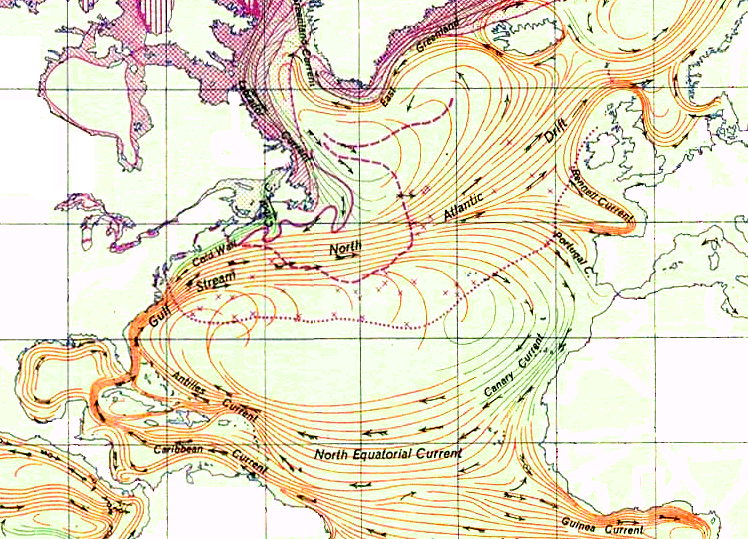
Zooming out: This is the North Atlantic Gyre. The currents of the world swirl sort-of-clockwise around the Americas and Europe, ending up spinning around in what is called the Sargasso Sea. Also mentioned in class, a lot of stuff tends to wash up there, be it trash or kelp or (hopefully more symbolically) people. In fact, there's a gross thing there called the North Atlantic Garbage Patch (which also would have been a good name for the novel). It is, you guessed it: just a bunch of plastic waste out on the ocean, and it's "hundreds of kilometres across in size." Nasty.
Image result for north atlantic garbage patch

Here are the West Indies.
Image result for West indies
See where we're going? Annette and Christophine are from Martinique (about in the middle of all those tiny islands). Rochester says that after he and Antoinette get married, they go on an "interminable journey from Jamaica," specifically mentioning going from Spanish Town (which is in Jamaica) to the Windward Islands (66).


So, Spanish Town is the capital of the parish of Saint Catherine, in the historic county of Middlesex, Jamaica. just saved you some googling.  In Part One, Antoinette talks about "the Jamaican ladies" near them and "the road from Spanish Town to Coulibri Estate," so Part One most likely takes place on Jamaica, moderately far from Spanish Town. The convent Antoinette stays at is "Mount Calvary Convent, Spanish Town, Jamaica, 1839." This place does not exist now, if it ever did; the best I can find is a facebook page.
Additionally, Rochester first arrives in the West Indies via Spanish Town, a bustling port city.


Martinique is an island claimed and ruled by France, even today. This is where Annette and Christophine are from.

Granbois (meaning 'big tree'), where Antoinette and Rochester stay in part 2, is near Massacre, Dominica. (Dominica is the island right above Martinique.)


And of course, I managed to find Shmoop's explanation AFTER I finished all this research.