Translation: Rebirth of Assorted Bloggery III, featuring African-American Lit. And something about this dude named Mothra.
May this semester be filled with complicated discussions and extrapolous blog posts.
background image is #23 from Jacob Lawrence's Migration Series: "And the migration spread."
August 27, 2018
May 14, 2018
Libra Is A Conspiracy Theory
Libra is one big conspiracy theory. Yes, it's based in facts. But so are other theories. Yes, it's well-written. But so are (some) other theories. What makes Delillo more able to compose a narrative than Nicholas Branch? How can we trust a guy who's telling us we can't trust any narrative, especially one given to you by someone in power (aka, an author)?
I've struggled with this throughout Libra. We're told that 1) the Warren commission is widely distrusted, and 2) There's a strong possibility that fake evidence was planted by who-knows-who. If the Historic Diary wasn't written by Lee, why does Delillo depict him writing it? If Lee's mother later says (effectively) "What if he was replaced by someone else in Russia" why don't we laugh at her, because we were reading the book and we know he wasn't replaced? Libra occupies that space in between History and fiction that we've been talking about all semester, but it leads to some plot holes and cognitive dissonance in the story. We're told that we can't be sure of a narrative, yet we're fed a narrative (with filled-in characters like Win and Raymo) that is plausible, but no more proven than any other.
Since I want to make this a nice wrap-up blog, I'll connect this idea to a few other books we've read. What makes any of them any better than a series of tame, slightly-less-important conspiracy theories?
Slaughterhouse-Five: Sci-fi is taking a big conspiracy theory (there's this dude who can travel in time) and applying it to a reasonably familiar setting (WWII). Within that world, everything makes sense. But I somehow can't imagine someone getting a cult following about a poor, confused, undocumented guy who maybe traveled in time. Part of what makes Libra so interesting is that it's about mostly real people (and stand-ins for real people).
Ragtime: The little "bubbles in time" and slots where something could have concievably happened? Those are where conspiracy theories are born. Maybe Houdini crashed his car once. Not a very juicy conspiracy, but a plausible one. But some things (like the two Harries in identically named, but different prisons) are totally fudging the details without telling the reader, making it not even a fictionalized history but a close-to-history. Is there anything in Libra that's actually contrary to facts, not just made up? Let me know in the comments, because I can't think of any.
As others have said, this has been a fun class, if a lot of work. I'm excited to see where my meta, #postmodern reading ability will take me next.
I've struggled with this throughout Libra. We're told that 1) the Warren commission is widely distrusted, and 2) There's a strong possibility that fake evidence was planted by who-knows-who. If the Historic Diary wasn't written by Lee, why does Delillo depict him writing it? If Lee's mother later says (effectively) "What if he was replaced by someone else in Russia" why don't we laugh at her, because we were reading the book and we know he wasn't replaced? Libra occupies that space in between History and fiction that we've been talking about all semester, but it leads to some plot holes and cognitive dissonance in the story. We're told that we can't be sure of a narrative, yet we're fed a narrative (with filled-in characters like Win and Raymo) that is plausible, but no more proven than any other.
Since I want to make this a nice wrap-up blog, I'll connect this idea to a few other books we've read. What makes any of them any better than a series of tame, slightly-less-important conspiracy theories?
Slaughterhouse-Five: Sci-fi is taking a big conspiracy theory (there's this dude who can travel in time) and applying it to a reasonably familiar setting (WWII). Within that world, everything makes sense. But I somehow can't imagine someone getting a cult following about a poor, confused, undocumented guy who maybe traveled in time. Part of what makes Libra so interesting is that it's about mostly real people (and stand-ins for real people).
Ragtime: The little "bubbles in time" and slots where something could have concievably happened? Those are where conspiracy theories are born. Maybe Houdini crashed his car once. Not a very juicy conspiracy, but a plausible one. But some things (like the two Harries in identically named, but different prisons) are totally fudging the details without telling the reader, making it not even a fictionalized history but a close-to-history. Is there anything in Libra that's actually contrary to facts, not just made up? Let me know in the comments, because I can't think of any.
As others have said, this has been a fun class, if a lot of work. I'm excited to see where my meta, #postmodern reading ability will take me next.
April 22, 2018
Annal History: Why Libra proves it's hard to pull off
Remember way back at the beginning of the semester, when we talked about Postmodern history? We thought about the different ways to display it: incomplete annals, complete omniscient annals, large-scale narratives implying smaller themes, "textbook" "unbiased" storytelling, and drawing connections that might not have been there (as Doctorow did in Ragtime.) At this point we could add a few more ways to tell History As Fiction™: Mumbo Jumbo told history by making up stuff based off of real events in order to paint a picture of history showing the themes he wanted to highlight. Slaughterhouse Five threw in elements of science fiction to illustrate the effects of WWII, and made a whole alien race that challenged the typical narrative of war stories (and, well, human life in general.) Kindred told history as an engaging, plot-driven story while keeping everything "historically true" in the world of the book. And now we find Libra telling two stories of different types and 'fictionalities.'
Style-wise, the location-based Lee story in Libra is closer to the Kindred or Ragtime way of doing things. The people in the story are almost all real (more so than in Ragtime), and the stories and motivations of the real characters are fictionalized because they weren't recorded. However, as noted in class, the Lee storyline is based more on facts than the FBI storyline, which concerns real events but many fictionalized people (perhaps like Kindred or Slaugherhouse Five).
But I want to focus on annal history: In an Annal such as the Annals of Saint Gall ("Charles fought against the Saxons," etc) we're given very little information. A more complete "list of events" might include births, deaths, and marriages, but even that is leaving out details. Historians would love to have that record, but it wouldn't create a narrative for the town (which is, debatably, the point of history.) So then you ask your deity of choice for an annal describing the feuds of the town, such as "Geoffrey beat up Paul for kicking Duke Gottfried's elderly cat." That gives a reason, but is not the whole story. I did a blog post on this messy topic a while ago, but the basic gist is you can't describe one event in history without connecting it to a thousand other previous events-- related to the Butterfly effect.
Part of the reason Nicholas Branch (and everyone who has tried to unravel the JFK assassination mystery) has trouble is that there is too much information. Hundreds of pages of documents (read: a detailed, researched annal of the locations, descriptions, thoughts, actions, and backstories of all the people in Dallas that day) don't help if you have a) no way to synthesize them and b) possibly not all the information. This, of course, is straight out of that postmodern history discussion: An omnipotent-annal history could work, but practically is impossible; the proliferation of conspiracy theories prove that more information doesn't necessarily mean a more definite answer, especially when theories suggest that information was falsely planted.
TL;DR The Warren Report and other clouds of information surrounding the JFK assassination are a bunch of facts (assuming they're true, not planted, somehow don't contradict). With all the conspiracy theories surrounding the "facts," it doesn't make a good case for "more information = more accuracy."
Style-wise, the location-based Lee story in Libra is closer to the Kindred or Ragtime way of doing things. The people in the story are almost all real (more so than in Ragtime), and the stories and motivations of the real characters are fictionalized because they weren't recorded. However, as noted in class, the Lee storyline is based more on facts than the FBI storyline, which concerns real events but many fictionalized people (perhaps like Kindred or Slaugherhouse Five).
But I want to focus on annal history: In an Annal such as the Annals of Saint Gall ("Charles fought against the Saxons," etc) we're given very little information. A more complete "list of events" might include births, deaths, and marriages, but even that is leaving out details. Historians would love to have that record, but it wouldn't create a narrative for the town (which is, debatably, the point of history.) So then you ask your deity of choice for an annal describing the feuds of the town, such as "Geoffrey beat up Paul for kicking Duke Gottfried's elderly cat." That gives a reason, but is not the whole story. I did a blog post on this messy topic a while ago, but the basic gist is you can't describe one event in history without connecting it to a thousand other previous events-- related to the Butterfly effect.
Part of the reason Nicholas Branch (and everyone who has tried to unravel the JFK assassination mystery) has trouble is that there is too much information. Hundreds of pages of documents (read: a detailed, researched annal of the locations, descriptions, thoughts, actions, and backstories of all the people in Dallas that day) don't help if you have a) no way to synthesize them and b) possibly not all the information. This, of course, is straight out of that postmodern history discussion: An omnipotent-annal history could work, but practically is impossible; the proliferation of conspiracy theories prove that more information doesn't necessarily mean a more definite answer, especially when theories suggest that information was falsely planted.
TL;DR The Warren Report and other clouds of information surrounding the JFK assassination are a bunch of facts (assuming they're true, not planted, somehow don't contradict). With all the conspiracy theories surrounding the "facts," it doesn't make a good case for "more information = more accuracy."
April 6, 2018
Magic Tree House: The Other Time-Traveling Observers
I realized this week that I had seen the time-traveling dynamics of Kindred before. In Magic Tree House, wholesome white 8-and-7-year-old protagonists Jack and Annie are summoned to their tree house when there's a mission to be done. They frequently get to their new time period just in time to save someone, and only go back once their "mission" is finished (not when they're in mortal danger, like Dana.) They are in a similar situation to Dana, although 1) they sometimes have other missions than saving someone and 2) they never go to the same place more than once for a mission.
As for being observers, their position is complicated. First off, they can take things with them both ways when they go on treehouse trips. Second, unlike Dana they can do some magic (to help Da Vinci's machine fly, inspire The Magic Flute, etc.) Third: some of the historical missions have a basis in history but little effect on it; they meet real historical figures mixed with convenient fictitious ones. I seem to remember Jack (the one who researches everything before and after they go, in order to sneakily teach readers something) finding a poem/document from someone they met that describes the two kids, meaning they made a mark on the historical record. But as we discussed in class, metaphorically it doesn't really matter. Fourth, it's canonical that their clothes and language change in order to fit in wherever they are, and we can see that in the cover illustrations; however, we don't see their race change, and it might take more than wardrobe for two white kids to fit in when they go to, say, Qin dynasty China. (to be fair, changing race would probably be more problematic.) They do their mission and leave, so individual missions don't have as much effect on them as Dana's. Finally, in keeping with the whole "3rd-5th grade reading level" thing the kids don't see anything remotely traumatizing like the race violence Dana sees and experiences.
I drudged through the Wikipedia page to see if Jack and Annie ever actually did go to the reconstruction/antebellum South. I suspected they didn't, and I was right. They approach the time period when they go out west (like Kevin wanted to, neatly avoiding the nasty stuff going down in the South. They meet a nice white cowboy named Slim, and no black people if I remember correctly!) They go to the Civil War, and the only mentioned characters they interact with are white. (If I had the book I would do further research. Maybe to be continued on my next post?) Many of the American-history stories are pretty okay even though parts are definitely sugarcoated and simplified for younger readers. Thanksgiving on Thursday gives a pretty realistic retelling of the first Thanksgiving, with minimal Pilgrim-Wampanoag buddy-buddyism. Blizzard of the Blue Moon, set during the Depression, doesn't focus on the depression as much as finding a unicorn. Yes, really.
It turns out, someone already wrote their Educational Studies thesis on the historical inaccuracies of the books, and why it's almost as important to give kids a gut-level link to those time periods through someone their own age. I personally find the results a little off, seeing as the author of the thesis "collected a total of 86 facts" from 28 books (seems a little small, for the supposedly historically immersive books) and at least partially verified 62 of those facts only through the World Book Encyclopedia 2010.
But back to Kindred: what if Magic Tree House decided to take Jack and Annie on an eye-opening, probably traumatizing romp to the Weylin plantation? Well, seeing as the two didn't hang with the slaves when they went to Pompeii (Book #13) or the civil war (Book #21), or with the lowest class at any time of racial/class divide, they would probably find themselves living with the Weylins, become friends with Rufus and spend a lot of time inside the house.They might meet Nigel or Alice in a nice, pleasant way. If Mary Pope Osborne were feeling rated-R Jack and Annie might watch a whipping or walk through the slave quarters, or maybe see them working in the field.
Now, I totally haven't done as much research as Octavia Butler on what would really happen. But we see in the book that Kevin is (obviously) treated differently than Dana is on the plantation, and sees different aspects while completely missing others. We can only assume that Annie and Jack would be the same, and would, like Kevin, get a warped view because of it.
This book would never happen, but there are some interesting ties to stuff we've seen before: Mumbo-Jumbo-Atonistically declaring a certain narrative "the truth," and putting characters in that narrative to teach kids "History," or Kindred's putting historians literally into the story to create more visceral truth, and how when you're actually participating in the story, you can't just be an observer, black or white.
As for being observers, their position is complicated. First off, they can take things with them both ways when they go on treehouse trips. Second, unlike Dana they can do some magic (to help Da Vinci's machine fly, inspire The Magic Flute, etc.) Third: some of the historical missions have a basis in history but little effect on it; they meet real historical figures mixed with convenient fictitious ones. I seem to remember Jack (the one who researches everything before and after they go, in order to sneakily teach readers something) finding a poem/document from someone they met that describes the two kids, meaning they made a mark on the historical record. But as we discussed in class, metaphorically it doesn't really matter. Fourth, it's canonical that their clothes and language change in order to fit in wherever they are, and we can see that in the cover illustrations; however, we don't see their race change, and it might take more than wardrobe for two white kids to fit in when they go to, say, Qin dynasty China. (to be fair, changing race would probably be more problematic.) They do their mission and leave, so individual missions don't have as much effect on them as Dana's. Finally, in keeping with the whole "3rd-5th grade reading level" thing the kids don't see anything remotely traumatizing like the race violence Dana sees and experiences.
I drudged through the Wikipedia page to see if Jack and Annie ever actually did go to the reconstruction/antebellum South. I suspected they didn't, and I was right. They approach the time period when they go out west (like Kevin wanted to, neatly avoiding the nasty stuff going down in the South. They meet a nice white cowboy named Slim, and no black people if I remember correctly!) They go to the Civil War, and the only mentioned characters they interact with are white. (If I had the book I would do further research. Maybe to be continued on my next post?) Many of the American-history stories are pretty okay even though parts are definitely sugarcoated and simplified for younger readers. Thanksgiving on Thursday gives a pretty realistic retelling of the first Thanksgiving, with minimal Pilgrim-Wampanoag buddy-buddyism. Blizzard of the Blue Moon, set during the Depression, doesn't focus on the depression as much as finding a unicorn. Yes, really.
It turns out, someone already wrote their Educational Studies thesis on the historical inaccuracies of the books, and why it's almost as important to give kids a gut-level link to those time periods through someone their own age. I personally find the results a little off, seeing as the author of the thesis "collected a total of 86 facts" from 28 books (seems a little small, for the supposedly historically immersive books) and at least partially verified 62 of those facts only through the World Book Encyclopedia 2010.
But back to Kindred: what if Magic Tree House decided to take Jack and Annie on an eye-opening, probably traumatizing romp to the Weylin plantation? Well, seeing as the two didn't hang with the slaves when they went to Pompeii (Book #13) or the civil war (Book #21), or with the lowest class at any time of racial/class divide, they would probably find themselves living with the Weylins, become friends with Rufus and spend a lot of time inside the house.They might meet Nigel or Alice in a nice, pleasant way. If Mary Pope Osborne were feeling rated-R Jack and Annie might watch a whipping or walk through the slave quarters, or maybe see them working in the field.
Now, I totally haven't done as much research as Octavia Butler on what would really happen. But we see in the book that Kevin is (obviously) treated differently than Dana is on the plantation, and sees different aspects while completely missing others. We can only assume that Annie and Jack would be the same, and would, like Kevin, get a warped view because of it.
This book would never happen, but there are some interesting ties to stuff we've seen before: Mumbo-Jumbo-Atonistically declaring a certain narrative "the truth," and putting characters in that narrative to teach kids "History," or Kindred's putting historians literally into the story to create more visceral truth, and how when you're actually participating in the story, you can't just be an observer, black or white.
March 18, 2018
Humor, Mental Blocks, and Billy Pilgrim
The character of Billy Pilgrim brings to mind my much-earlier
blog post trying to deal with Why Postmodernists Do Weird Things. You would think
Vonnegut is much more in the “for-the-hell-of-it” camp with this one, what with
the plunger-shaped Tralfamadorian aliens during what is ostensibly a war
memoir, or the tasteful drawing of Montana Wildhack’s locket at the end. In
research for this post, I found a great Vonnegut quote; he says that his books “are
essentially mosaics made up of a whole bunch of little chips… and each chip is
a joke.” And yet, we discussed in class how humor and defamiliarization are an
escape. World War II seems much different when you call it artificial weather
or focus on the squishing, farting humans or just laugh at the sheer absurdity
of this guy who ends up in a curtain toga during the apocalyptic bombing of a German
city. Vonnegut’s creation of Billy Pilgrim and the ridiculous plot he stars in
is a coping mechanism and a symbol for the war itself.
First: Billy is the ultimate veteran as someone who is constantly
with his war days. At one point Billy doesn’t go back but just remembers (and
this is emphasized in the book too, that he is remembering) his time as a
soldier, and that he had never done that before. The Tralfamadorian time-jumps
lend a sort of dreamlike quality to the book, and the remembering makes Billy
seem a little more conscious in his storyline. (Something, I suppose, Tralfamadorians
would laugh at. What does it matter to look “back,” if what will happen will
happen anyway? Relatedly, does this make Billy a pillar of salt like Lot’s
wife?)
Second: We mentioned in class how circuitous the path to the
bombing really is. In chapter one Vonnegut sits us down and says “this book is
about the bombing of Dresden.” Then he keeps saying, “the bombing will happen
soon.” Then, right before the bombing, he goes on a series of about five related
time-skips involving Campbell, Montana, and his wife, among other things. Not
only does this take a page out of the Tralfamadorian novel handbook, showing
many related scenes in succession to create a specific feeling, it also gives a
good idea of the mental hurdles a veteran would have to overcome to talk about
his experience. Valencia asks Billy about the war and he sprints to the
bathroom. Then he’s talking to Montana Wildhack and is able to talk about the
war. Since Billy doesn’t really have a sense of time, it’s not time that made
him more comfortable with Montana. I think the sheer ridiculousness of being on
an alien planet, in a human exhibit with an adult film star that said aliens inexplicably
decided would be the best other human for the job, with her, baby on hip,
sympathetically asking you about the war—it detaches Billy just enough from real
life for him to be able to talk more openly about the war. Compare this to
Valencia and Billy’s lackluster, very real-world marriage. It’s the difference
between a dream and reality, almost. And wouldn’t you feel more comfortable
doing something strange and out of the ordinary in a dream, rather than in real
life? (e.g. you’re dreaming about a test, and you get an urge to yell as loud
as you can. You do, and nobody notices. The next day you’re taking your test
and you wonder what would happen if you yelled. But you don’t.) And after Billy
tells Montana about Dresden, we finally see it happen in the narration. In my
opinion, this is solid proof of both Kurt Vonnegut’s own mental blocks and the
use of defamiliarization and humor to get past them.
March 2, 2018
Cartoonishness
We devoted a fair amount of class discussion to Mumbo Jumbo as a movie or cartoon. The problem, of course, arose from how caricatured the characters should be. At some points the novel seems almost like it takes itself seriously, setting a more realistic mood for our proverbial movie. Then something ridiculous and silly will happen, or some character is an unrealistic caricature, and we need something more emotive and expressive than real life. Some things are portrayed the same way throughout the book, and others use that code-switching humor my panel presentation group discussed (i.e. using a weird shift in language to throw you off guard and make you think, also putting language in juxtaposition. Reed uses this a lot, shifting from Black vernacular English to "formal" english even when it doesn't make a lot of sense to do so, such as the Wallflower Order's inexplicable proclamation to “Knock It Dock It Co-opt It Swing It Bop It or Rock It!” p. 118.)
So how do you mix cartoonish and realistic styles in a movie? One option would be a realistic cartoon like Archer. The character models for Archer were based off of real people, but being animated allows for handy things like grisly death, without real danger to actors or special effects. But the characters aren't really caricatures, and don't change style, making them not quite right for a Mumbo Jumbo.
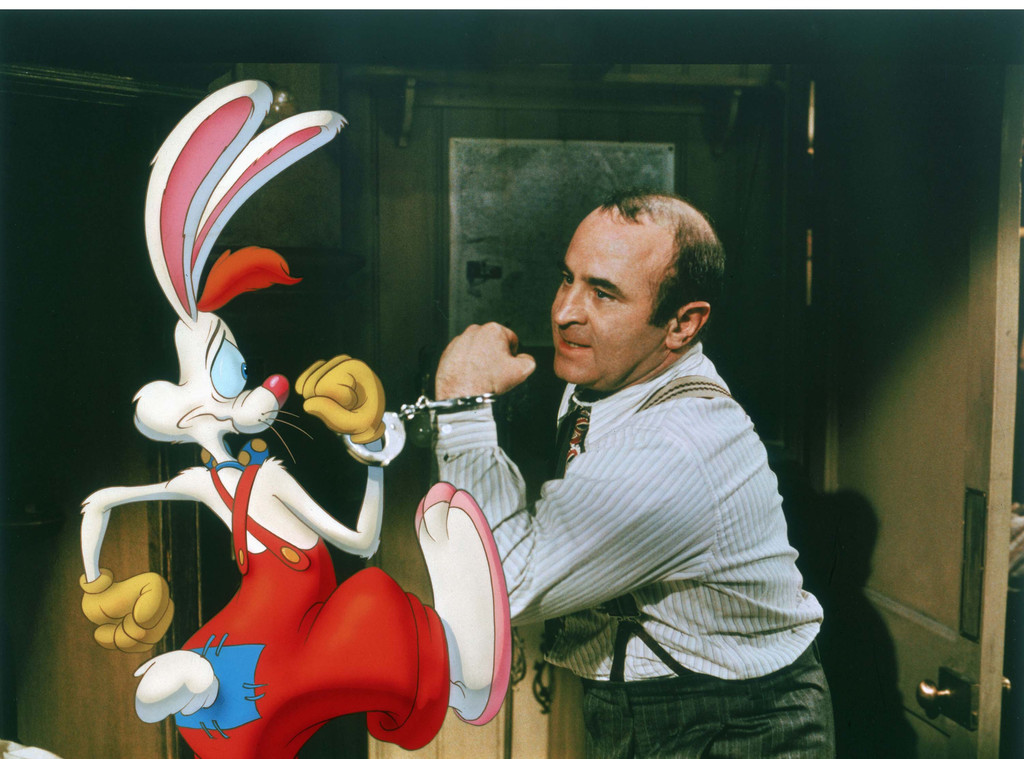
There's also the style of Who Framed Roger Rabbit (1988). It has a mix of comically animated and live-action characters that bounce off each other and interact in a way that was radically new at the time.
Of course, there's a spectrum of realistic versus cartoonish in every animated show. Animes tend to switch styles based on the seriousness of the topic: think One Punch Man's Saitama when relaxed versus fighting. I think Mumbo Jumbo: The Anime could be a good time, honestly.
As for what the characters themselves would look like, I made a goofy little drawing of Hinkle Von Vampton as I imagined him whenever he was mentioned. He's somewhere between the Duke of Weselton from Frozen and that weird mountain goat dude from Hoodwinked.
Thanks for reading my ramblings!
So how do you mix cartoonish and realistic styles in a movie? One option would be a realistic cartoon like Archer. The character models for Archer were based off of real people, but being animated allows for handy things like grisly death, without real danger to actors or special effects. But the characters aren't really caricatures, and don't change style, making them not quite right for a Mumbo Jumbo.
There's also the style of Who Framed Roger Rabbit (1988). It has a mix of comically animated and live-action characters that bounce off each other and interact in a way that was radically new at the time.
Of course, there's a spectrum of realistic versus cartoonish in every animated show. Animes tend to switch styles based on the seriousness of the topic: think One Punch Man's Saitama when relaxed versus fighting. I think Mumbo Jumbo: The Anime could be a good time, honestly.
As for what the characters themselves would look like, I made a goofy little drawing of Hinkle Von Vampton as I imagined him whenever he was mentioned. He's somewhere between the Duke of Weselton from Frozen and that weird mountain goat dude from Hoodwinked.
Thanks for reading my ramblings!
February 10, 2018
Bias and Butterflies
Bias and lying by omission is the easiest kind to do,
intentionally or not. If no records exist for, say, a certain French peasant
circa 1400, you’d be forgiven for not knowing their life story. But an omniscient
historian with infinite historical knowledge could still tell a biased story by
not writing every single detail into their historical account. An “annal
history” of every single factual event that happened in human history, in chronological
order and with (somehow) no subjective wording would be great. It would also be
a gazillion pages long, and near impossible to use/read. So in order for it to
be usable, you would create condensed versions. And is that French peasant REALLY
important to your “exhaustive history of the American Wild West”? Of course!
Had that French peasant not moved his cart during a rainstorm, a tree would
have fallen on the daughter of a visiting merchant—who, of course, would be the
great x15 grandmother of Buffalo Bill. And what is the Wild West without Buffalo
Bill?
p.s. tell me if my blog is doing that thing where it runs off the side of the page.
You’ve probably heard of the butterfly effect, which says
that a butterfly flapping its wings affects human events far in the future. Maybe
a butterfly flap caused a minute change in weather patterns that would warp
into a tornado that destroyed Rome. If all of human history is interconnected, you
really can’t tell the complete (and therefore not inherently biased) story of one
thing without talking about everything that has ever happened. It’s a little ad
absurdum, but I like thinking about history, and the sheer chance that
everything turned out the way it did because of one little butterfly.
Kind of related to bias by omission is bias by narration. A
king living in his palace knows his life: his surroundings, his food, his
drink, his opinions and ideology. And as the most powerful and influential person
in the area, his knowledge is a reasonable
“history.” Then imagine the scribe of the annals we read in class, who
writes “712. Flood everywhere. / 713. / 714. Pippin, mayor of the palace, died.
/715. 716. 717.” Presumably nothing happened in 713, 715, 716, or 717 that was
of interest to the scribe or to the town of Saint Gall. But what about the
history and story of the 709 hard winter during which Bede the presbyter had a religious
experience, which caused him to become Blessed Bede by the time he died in 731?
(A little bit of a ridiculous example, but made to show how the private lives
of the common people can have a big impact later.) The king and the scribe are
not wrong to say “these things happened and are important.” Bede the presbyter
is not wrong to say “my life happened and is important.” But for the most complete,
unbiased historical account we would need both the history of the common people
and of the king. Of course, we don’t get it because records of kings tend to be
better preserved than those of poor, illiterate peasants.
p.s. tell me if my blog is doing that thing where it runs off the side of the page.
Subscribe to:
Posts (Atom)